Thursday, October 12, 2017

Either ETFs cools down or I am dead

I may be chicken little and think the sky is falling, but it is unclear what my financial analysis skillset in will get me in the future, especially the long run.

Financial professionals often tout the power of free markets. They speak highly about creative destruction and speak with ease about re-training programs for those left behind. However, they, including me, may get a taste of their own medicine. Challenges from passive investing may render the traditional finance skillset useless and anachronistic for many. Either ETFs cools down or I am dead.

It came fast and furious, passive investing through ETFs will account for about 50% of all assets under management by 2017-year end. As more people put their money into ETFs, fewer people are putting their money in mutual funds and hedge funds. So far, there is a good reason for this. Since QE started in 2008, the broad market has been performing very well. While good stock/bond picking is nice, investors say no thanks when the whole basket of stocks/bonds was rising. It is reasonable to say that ETF will cool down because the market will eventually underperform active management, especially when global QE stops.

However, I worry this won’t be the case. Overtime, it may be become a habit that is hard to kick. After Japan suffered its bubble burst, cheap 100 yen stores selling daily items sprung up and became part of life. 30 years later, it does not matter whether one is rich or poor, they all go to the cheap 100 yen stores because it is a part of life. It also may be a genuine low cost disruption that is here to stay. Regardless of whether it is piggy backing on QE or not, ETF is a true innovation in terms of its efficiency and cost. Similarly, fast fashion, ecommerce, ride sharing, and streaming have toppled their incumbents in recent years and have not looked back. Lastly, the case for ETF may be tied up in the same mystery of low inflation. In this low growth and low return era, it is reasonable for investors to want to minimize their management fees because they lack confidence.
*ETFs may also blow up and start a financial crisis due to its now wacky construction, liquidity concerns, and bubble characteristics. However, this discussion deserves a blog post of its own.

As of now, it is hard to say conclusively whether this is a big fad or a big seismic shift, but either way it is impacting the financial industry ecosystem. Due to the accessibility and popularity of ETFs through robo advisors, financial advisors who make commission from helping investors are hurting investors opt to “Do It Themselves.” Trickling down to the next level, since people are buying ETFs instead of mutual funds, money managers who charge a fee off their assets under management are pressured. Further down the chain, investment banks who relied on money managers’ trading business are also hurting. There is a chance that a counterbalance will set in since the ecosystem change will impact the market in the long run, whether in its liquidity, asset allocation, or productivity. However, until then, the pie for financial analysts has shrunk and is shrinking.

Additional forces that threaten to reduce the size of the pie are regulations. A European regulation called Midfid II will dictate how money managers pay for research and it will lead to job losses. Before Midfid II, money managers paid for research through soft dollar, which means they paid for research through their trading commission they pay to the bank. Banks agreed to it because at the very least, research was another service differentiator that helped them stand out amongst the competition. Given the debates around the usefulness of investment bank research and the squeezed margins for money managers, many research firms will be caught swimming naked. Eventually, the bottom performing research will get cut. Another US based regulation called Fiduciary Duty Act, which aims to improve transparency and accountability, will force financial professionals act in the best interest of their clients. One direct effect is that financial professionals will now opt for the cheapest and most convenient options because they want to stay out of trouble. Since ETFs are cheap and popular, they will direct clients to ETFs because they don’t want to have to explain themselves.  

The passive management and current regulatory trend may be the perfect storm for industry professionals. The laid off investment bank research analysts will rush to get jobs at money managers, but money managers are constrained. Not only is their revenue shrinking due to challenges from ETF, but also their expenditure is growing because are forced to pay for research. This means that a crowd of people will rush to squeeze into an already crowded and possibly shrinking room.

As I said before, it is unclear what my financial analysis skillset will get me in the future. If ETF is here to stay in the long run, then a financial analyst may become no different than the horse breeder in early 20th century. Both professionals have nice skills and both were valuable when horse carriages and active management mutual funds ruled the world. However, if ETFs becomes what car is to horse carriages, then financial analysts may suffer the same fate. They either have to become the best analysts in the world and work for Warren Buffet, similar to the horse breeders who work for the few domestic and race horse owners, or they have to re-train and find a new job. They either have to find something translatable or go into the automobile or new finance industry.

I maintain that either ETFs cools down or I am dead. Just kidding, I won’t be dead. I will just have to think hard about where else I can apply my skills or re-train for a new craft. I will not be the first to experience this type of industry shifts, nor will I be the last.

*I will follow up with my own rebuttal piece about why I may also be wrong and why the sky is not falling down. 

Thursday, June 22, 2017

Casino Like Financial Markets


In this world where too much money is chasing too few assets, asset price inflation and subsequently, gambling on prices, become inevitable. This means that financial markets may turn into casinos, but this outcome is better than the alternatives.

To begin, money and assets are different in that money is cash, deposits, and cash like funds while assets are things that provide future benefits. In the past 70 years, the combination of post WWII peace, globalization, and the break from gold standard has led to the creation of lots of money. Peace allows households to just live and enjoy life, giving them the opportunity to make money without interruption. Globalization enables those who are good at making money to make lots of it. Lobster men in Maine and miners in Mongolia can now sell their goods far and wide at speeds and scales unseen before. Fiat currency made money printing possible. Whether the printing is to meet genuine economic demand or spurred by government stimulus, central banks no longer had to worry whether they have enough gold to back their money up. Putting it all together, it has been a perfect storm for money creation.

As for assets, there is simply not enough of it. There are lots of consumption goods, but there are not enough investment goods. While they both provide future benefits, only investment goods are assets worth chasing with one’s money. Since consumption goods’ values expire and depreciate, it makes little sense for people to park their money in these assets that lose value. As a result, money naturally gravitates toward investment goods, lured by the promise of capital preservation and appreciation. (Preservation is important because inflation eats away the value of money and appreciation is desired because what is a better way to make money than to make money with money).

What does this mean altogether? It means that asset prices will rise over time since there is too much money chasing too few assets.  Money has to go somewhere and it will pour into available assets. However, the process is messy and unpredictable (largely). The inflow of money is disorderly, unlike water filling an ice cube tray. Money will come in and out and assets will rise and fall. This volatility makes it difficult for assets to find and stay at an equilibrium price. Such opportunity to make quick bucks by predicting the direction of prices draw people in and those who captured by their animal spirits turn into gamblers. Also, as markets become more sophisticated, the typical buy low sell high strategy has evolved beyond one’s imagination. Instead of picking good stocks or a good house, there are now strategies betting on prices, interest rates, exchange rates, spreads, volatilities, and everything else.   

However, this is not a bad thing. This casino is better than other forms of gambling. Financial markets create much more good than Las Vegas’s casinos or horse race betting. Furthermore, it is much better to isolate the gambling on investment goods than consumption goods.

First, unlike Las Vegas and race tracks that end up creating lavish hotels and genetically engineered horses, this casino allocates capital, creates endless jobs, and spreads financial literacy. Though gambling sounds bad, the large number of market participants help enable a deep market. This deep market increases the possibility of someone out there willing to take the other side of the trade as a buyer or a seller. Whether it is buying a stock, foreign exchange, or an interest rate swap, one can feel confident that their transaction will go through at a given price. Through this deep market, resources can be allocated more efficiently. Stock picking rewards good companies by giving them a cheaper cost of capital. Foreign exchange forwards allow companies to put their idle foreign exchange to good use to those who wants to buy it now for the future. Interest rate swaps enable companies to swap their less desired fixed interest rates for a preferred floating exchange rate. Also, ever since financial markets evolved from a room of loud traders to electronic markets that now exists in the clouds, financial markets can now create jobs anywhere. In comparison, the jobs created by casino and race tracks are mostly limited to those within the proximity of these sites. Lastly, working as part of the value chain of financial markets, one is able to become an expert in financial matters. These workers are not only able to use these skills for themselves, but also become agents to spread financial literacy to others. Financial skill is much more applicable and useful compared to knowing how to deal in black jack and knowing how to brush horse’s hair.  

Second, it is much better to have this casino on investment goods than consumption goods. If the flood of money is channeled toward chasing consumption goods, it would no longer be known as capital appreciation, but as hyperinflation. The first allows people to preserve and grow their wealth while the second destroys their wealth through the erosion in their purchasing power. One is happy to see his or her 401K investment balance goes up, but one will be distraught to see the price of daily items spin out of control. One observable example can now be seen through housing. Homes are both a consumption good and investment good. People consume housing for shelter, but they also invest in homes for their retirement. The dual purpose real estate serves doubles the demand for this asset. As a result, home prices have skyrocketed in past decades as more and more wealth chases this asset, which often struggles to keep up with the demand. This phenomenon has forced poorer people out of their neighborhoods at best and created destructive housing bubbles at worst. Even till today, housing continues to be a thorny issue despite the numerous painful experiences of housing bubble bursts in Japan, US, Europe, and elsewhere.


In the end, we are left to choose our own poison. By accepting conflict, protectionism, and gold standards, one can create a world with less money. However, the weak and powerless will undoubtedly suffer more. Destruction is more costly to them, protectionism hurts poor nations’ income and deprives rich nations from cheap goods, and gold standards limit stimulus and cheap credits. If one accepts the current arrangement and let money creation continue, then one may be left with hyperinflation or casino like financial markets. I do not know about you, but between the two, I pick casino like financial markets. 

Thursday, August 25, 2016

Why Everyone Should be a Fed Watcher


Heading into Jackson Hole, many financial market participants are eagerly watching Fed Chairwoman Yellen’s every move. As if they are not already, they will be glued to their smartphones and tablets, watching out for any pop up news of Yellen’s speech. They want to know if September is a go.


Image result for federal reserveThis go means Fed hikes rates. To profit and loss minded investors, this will be huge news. The rate hike will determine whether the dollar will resume its appreciation, the equity and bond market will deflate, and international markets will slow down. To casual followers of capital markets and the economy, this means that the government believes in the strength of the US economy and maybe their mortgage rates will go up. However, to most people, this means nothing. Whether young or old, they will look up at their TV, stare across at their computers, or swipe away on their smartphones, thinking “I don’t care and this is boring.”
I do not blame them, but I believe everyone should be paying attention to the Fed and this is to their own benefit. The anticipated 25 basis point interest rate hike, when and if it comes, has a butterfly effect on everyone and those who predict it well has the best chance of survival and prosperity. You may think I am exaggerating, but hear me out.
Just like farmers rely on the weather, modern workers rely on the economy. A farmer can be diligent and resourceful with seeds, but if the weather and conditions are bad, the farmer’s crops will go nowhere. Similarly, a modern worker can be hard working and endowed with money or education, but if the economy trajectory and economy are bad, the workers will have very limited success. A new home buyer couple, a college graduate and a middle management dad during the 2008 financial crisis all suffered. The couple ended up overpaying for a house and are stuck paying mortgage for the next 30 years. The student who did everything right, but still fell short of finding a job after school. The dad, who helped the company throughout the year, got laid off because the corporate said so.
As a result, it is easy to see that the weather and economy have a great impact on the farmer and worker. The difference is that good farmers try their best to predict the weather and adapt to different conditions while good workers generally have little understanding of the economy and allow the economy to batter them around without any adjustment or a clue. At this point, one may have two burning questions: what can workers do and how can they predict the economy?
For the first question, it is no different from the farmer. Just like the farmer who foresaw the poor rains this season and decided to plant a less water intensive crop, one should evaluate conditions before making a big purchase or investment. Whether it is buying a house or going to school, people should make sure their plans (crop) fit the economy (weather). If their plans do not fit, then they should be open, if not eager, to change. The ever growing students at coding schools are a perfect example of this change. Perhaps interested by tech or discouraged by their current field, people adapt to learn skills that seemingly will fit the economy. There is no way for sure to know whether this will work out, but it beats the odds of the stubborn farmer who refuses to leave his barren land.
As for the second question, I say watch the Fed. The Fed is not only stacked with brilliant economists and researchers, but also it is tasked with changing the economy (weather). To understand what I mean here, imagine how farmers observe and predict the weather. The Fed is more than just a wise and experienced farmer who watches the clouds, feel the wind, and observe seasonal patterns to predict the weather. The Fed is an Elon Musk like disrupter who will play god to change the weather and economy. The Elon Musk reference is to his proposal to nuke Mars to induce create a sun and warm up the planet for future inhabitants. Well, unless one thinks Fed’s QE is on the level of Elon Musk’s idea, one should just think of the Fed as a modern day engineer who cloud seeds for rain and build dams and levers to control water. (I will stop here because this is not a blog on Fed’s monetary policy channels, communication, and impact) Therefore, by following the Fed, one should be able to understand the current and future trajectory of the economy. Before people were treated as robots and shuffled inside giant factories or office buildings, they paid attention to and adapted to weather. Today, people should take back this skill and pay attention to and adapt to the economy.

Just like sailors do not set sail without checking for storms, people should not live their lives without paying attention to the economy. The captain and crew can pray to their gods all they want and wish for smooth sailing, but the storm will find them if they do not check and prepare for the weather. People can find “the economy” boring all they want, but the economy will find them if they act like it has no relevance to their lives. Fast forward a few 100 years, it is now easy to find any weather information that is timely and accurate. However, information and accurate views on the economy is more difficult. Given there is no app that will tell you everything you need to know about this week’s weather with just a quick swipe, just do your homework and study the Fed.
http://filmint.nu/wp-content/uploads/2015/01/interstellar-farm-550x230.jpeg
So is Murph’s brother Tom a good farmer? He is on a doomed planet, but he does switch around his crops…

Sunday, July 24, 2016

Moon, Stars, Wage Growth Next?

We all know the cliched saying, "always aim for the moon, even if you miss, you will land amongst the stars." This saying usually applies to parents who are trying to motivate their children, but it is increasingly taking shape in the economic and finance world. I got the idea reading the diplomat's coverage of the World Bank President, Dr. Kim. Dr. Kim aimed for the moon with his "3-by-5 pledge." He states that he aims to treat 3 mn people in developing countries with an anti- HIV/AIDS drug by 2005 during his tenure at the UN. The pledge ended up being unfulfilled, but the 3 mn target is reached in 2007, earlier than previous expected. Kim says his policies worked because "you have to set a really difficult target and then have that really difficult target change the way you do your work.” He has employed the same philosophy at the World Bank, but tackling poverty's causes and effects simultaneously is a very difficult challenge. Needless to say, he has yet to "land amongst the stars" at the World Bank.


This idea has also played out in industrial policies. South Korea's Park Chung Hee implemented policies that led to Korea's future industrial dominance. South Korea is now market leaders in steel, shipbuilding, autos, chemicals, and electronics. By striving to reach difficult output or export targets, chaebols were pressured to make significant breakthroughs in short amounts of time. This achievement did not come easily since the foreigners, importers, consumers, and laborers' interests were sacrificed in the process, but they did it. Though they often missed out on short term targets, the difficult goal helped them move with more urgency in improving their operations, technology, and management. This all sounds well and good, but China under Mao was a different story. Ambitious targets to beat US and UK in steel output during the Great Leap Forward led to disastrous outcomes. Drunk with hopes of a new China, wishes for a egalitarian society, and spells of Mao's cult of personality, people dived into this project with fervor. Seemingly overnight, useful bicycles, cookware, and machinery were dumped into giant furnaces and turned into giant heaps of metal crap. Great Leap Forward's bold goals were equivalent to aiming for mars, but China did not land among the moon or the stars, it landed into an era of shortage, starvation, and social upheaval.

Increasingly, this idea has expanded to foreign currency and inflation. Taiwan, the lagger in the four Asian tigers, has failed to meaningfully upgrade its manufacturing industries. Sure TSMC is a big name, but Taiwan has performed below its potential and created fewer competitive firms than expected. One criticism is that the central banks' cheap currency policy has shielded exporters from competition and deprived them of the urgency to upgrade. Recently the central bank has even released a 33 page report responding to a magazine critical on the central bank and its foreign exchange policy. In Japan, academics like Paul Krugman are calling for a 4% inflation target in Japan; the higher inflation rate is expected to help reflation policies since a failure to hit the target will still result in inflation higher than that of today's 0.7%. This policy also gives the government cover for much bigger forms of monetary policies. These talks seem tantalizing, but foreign currency and inflation targets are complicated and policy makers will always err on the side of caution. Considering it is difficult enough to maintain the status quo rather than improve the current situation, do not expect much aiming for the moon.


One part where the cliched saying may evolve next to is in wage hikes. Seeds planted from the 2008 financial crisis has grown to many social movements. From the on start of the Occupy Wall Street movement to Bernie Sanders and Donald Trumps' rise, economic inequality has played a big role. At the moment, given US's high debt and overall political leaning, wage hikes rather than welfare is a more realistic situation. In a country built by self-sufficient and dreamer immigrants, working to help one escape poverty is an acceptable narrative. As the likes of Wal-Mart laud the positive business effects in paying their employees' above market wage and Dimon announces wage hikes at JP Morgan, more meaningful wage hikes has gradually turned into expectation. Furthermore, as cities around the country, from LA to SF to NYC aim to raise wages to $15 an hour, this movement just keeps on growing.


Despite this trend, there is no lack of opposition. Citing price and quantity crosses featured in economic 101 courses , economists believe that wage hikes will decrease overall employment. This economic law is sensible and logical, but the price and quantity cross is not everything. The supply and demand curves are dynamic and next to impossible to capture in frameworks that assumes "ceteris paribus," or everything else the same. However, the louder the critics sound off alarms on wage hikes' negative effect on employment, the less likely cities and corps will stand idly watching their jobs flow out or payroll bloats up. In anticipation of wages hikes' effect on lower employment, cities and companies may compensate for this by adjusting policies to create more opportunities or productivity. Local governments may remove previous red tabs; companies may use new methods to increase productivity. Overall, despite the set backs, perhaps the wage hikes will be a disruptive force that leads to positive shifts in the supply and demand curves rather than a mere change in the price and quantity cross points. I do not have a good way to validate this narrative one way or another, but I do wonder if wage policy will become the next hot bed for the "aim for the moon and land amongst stars" philosophy.


Thursday, November 26, 2015

Inflection Point

Now approaching the year end, many countries or institutions are beginning to choose their word of the year. For Oxford Dictionary, it chose an Emoji for 2015. For Japan, the Prime Minister will choose the Kanji of the year. For the finance community, my vote definitely goes toward China.

South China Sea, RMB revaluation, AIIB and One Road One Belt aside, people ultimately just care about the economy. Policy makers, economists, investors, and businessmen all want China to continue its high growth, if not just stable growth. Some claim that China needs its high growth to maintain government legitimacy and avoid social unrest. some say China needs its high growth to keep the debt fueled economic churning and avoid a financial crisis. Some even cite neuro scientists who say people lack the ability to process large numbers. As a result, the pressure for high GDP growth is unwarranted since the additional GDP added through China’s 2014 7% GDP is equivalent to 15% GDP in 2010 terms.

However, just because making things bigger is hard to achieve or difficult to grasp, does that mean people stop trying? For the most part, I believe the answer is no. This explains why the world has so many policy makers, central bankers, economists, investment bankers, and businessmen finding what I call the inflection point.

These inflection point determines the point in which the input no longer contributes or no longer effectively contributes to the output. This is the point of diminishing marginal return. I believe at the end of the day, that is what every economic planning agent is trying to do.

Policy makers run models to find the optimal tax rate to maximize tax revenue. This optimal tax rate may be close to the the maximum tax the government can levy on its workers without disincentivizing them to stop working altogether. This rate bears huge implications and have great butterfly effects; it influences the subsequent welfare policies, public investments, technological progress, asset prices, and debt management. For instance, the amount of tax revenue influences how much a country can borrow. A country needs to borrow enough to keep the government running (if it cannot generate enough through taxes, which is the case for nearly all countries), but its debt burden also cannot be so large that it crushes its people’s economic sentiment.

Central bankers run models to conduct the optimal monetary policy to maximize growth or price stability. This optimal monetary policy, money printing or draining through the form of central bank asset purchases and sales. During times of inflation, it needs an interest rate high enough to squash inflation, but hopefully not so high that the economy crashes. During times of deflation, it needs an interest rate low enough that generates demand, but hopefully not so low that the system breaks down in the form of banking deposit outflows or bad loans.

Investment bankers run models to find the best debt structure to help a company find the cheapest money for whatever it wants to do. The optimal debt structure helps the company take advantage of whatever the tax codes and capital markets throw at the company, resulting in money that can contribute to greater growth, market share, revenue, or anything else.

I believe the same inflection point idea applies to people, too. People want the optimal debt structure, one where they can borrow to finance their education and home without feeling squashed and hopeless. People want the optimal tax rate so they can vote for the political candidates who share their aligned values without the fear of extortionary taxes.

As for to China, President Xi and Premier Li are looking to find the optimal interest rates, optimal tax rates, optimal industry mix, and optimal capitalist system to help China weather through its difficulties. Regardless of whether it will be able to achieve its goal, the GDP treadmill pressure may always be there. “Bigger, louder, and more teeth,” those word echoed in Jurassic World relate to our world. Countries want bigger GDPs, companies want bigger market shares, revenues, or both, investors want bigger EPS, and workers want more money.

My last point, considering how difficult and stressful it is to find the inflection point during our busy work days, it is now a good time to think about the optimal work life balance that gives you a full and happy life. Happy Thanksgiving and Happy Holidays!


Saturday, March 28, 2015

Balloon Economies (Part 1)


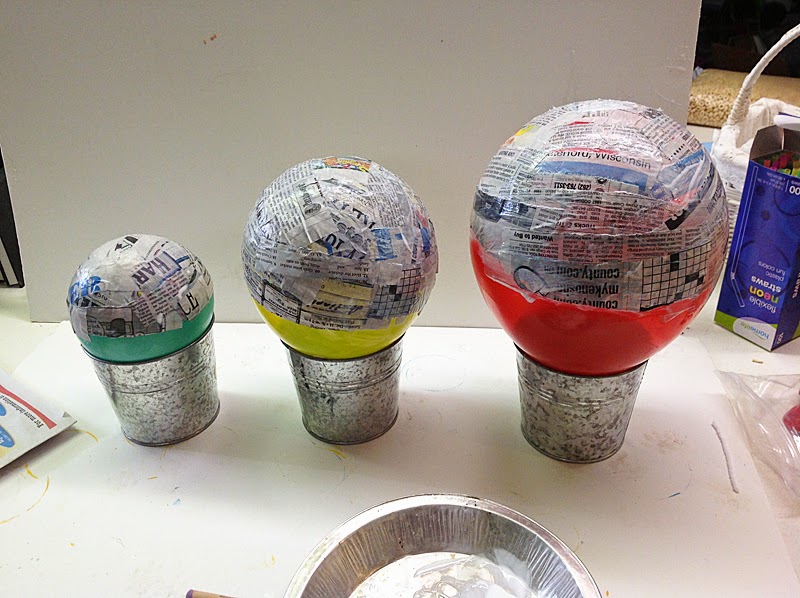
What do you see here? Three work in progress paper mache projects? I see that too, but I also see something more. I see the balloon pasted paper mache as a metaphors that explain economic booms and busts and economic policies.

While I do not know why the artist (who uploaded this picture) wanted big paper mache domes, I do know why politicians want big economies. Big economies empower countries, bolster support, and provide better livelihoods. Especially on the last point, whether motivated by love, duty, power, or pride, politicians strive to improve their countrymen’s economic well-being. Some may say that the pie is big enough and society needs more re-distributive policies to address inequalities. However, given the high political cost and the economic inefficiencies, I believe politicians still see making the economic pie bigger as the simpler policy choice.

As a result, no different from the artist who used the balloon to prop up the paper mache dome, politicians also look for ways to build the economy as big and as quickly as possible. In the picture’s case, the third largest balloon allows the economy to have the biggest GDP and its people the highest GDP per capita. In this scenario, people’s material wealth increases, the government fulfills its promises, and everyone is happy. Here, politicians and entrepreneurs are lionized as geniuses and saviors.

However, the paper mache dome and the economy dome comparison now ends here. While the artist has complete control over when to lift the solidified dome off the balloon or even burst the balloon intentionally to remove the dome, the government does not. The government did not know whether the San Francisco economy is able to wean itself off the dependence on the Tech bubble. The government did not know whether the US economy could hold up if the housing bubble burst. In the end, the ordinary folks who the government sought to help in the beginning are hurt the most. Seemingly overnight, 401Ks are reduced, home equity are halved, and entire departments are laid off. The US economy went through this bubble bursting in 2008. Seven years later, the economy is now finally starting to pick up.

Quick Lesson from LKY's Passing

With the passing of Lee Kuan Yew, the world has been extra critical in debating his legacy. No one disputes Singapore’s economic progress achieved under his 31 years of PM rule. However, many also see him as a ruthless autocrat who cracked down on free speech and political opposition senselessly. Lee Kuan Yew is well aware of these criticisms. He believes there is no freedom without order and people value economic freedom more than political freedom.

Seeing himself as Singapore’s father who knows what people need best, he says “you take a poll of any people. What is it they want? The right to write an editorial as you like? They want homes, medicine, jobs, schools.” As a result, he has made his utmost effort in building Singapore’s prosperity, not democracy.

Now, I am not here to debate whether Lee Kuan Yew is right. I am here to talk about cultural understanding. For the most part, Westerners are more critical of the political repression while Easterners are more forgiving of such human costs. Having grown up in the East and West, I understand the historical vestiges, the government agendas, and the family upbringing that contribute to this different interpretation of Lee. However, for most of the world, people grow up with one dominant value system. As a result, cultural misunderstandings are bound to happen right? I disagree.

The pace of globalization post the fall of the Iron Curtain has caught the world by surprise. It seemed like just yesterday when people still used point cards to dial internationally. (I vividly remember my parents dialing a million digits just to have a ten minute conversation with family abroad.) Now, internet, smartphones, apps have bridged all gaps, except cultural ones. Now on to the final frontier, how do we overcome cultural differences? I believe replacing heuristics with common sense is all we need.

When one uses heuristics, judgement shortcuts, to approach another culture, one is bound to pigeonhole the said culture to either end of the extreme. Cultures are never inherently exotic or common; it all depends on the frame of reference. Just because another culture’s food seems exotic does not make the said culture’s values alien. Just because another culture’s life style is western does not make the said culture’s beliefs western. Heuristics that simplify a culture’s complexity down to a simple transitive equation are inadequate for today’s society. The walls have come down, but the neighborhoods are still divided. Cultural sensitivity issues, most analogous to the left over barb wires from the torn down walls, scare people away. However, there is nothing to be afraid of. Common sense over heuristics is all one needs to understand other cultures. Like most things in the world, the truth is always somewhere in the middle so book that flight, sign up for that exchange program, follow that blog, and explore all that the world has to offer.